
In the first blog post of this series of three, some basic information was given about the hidden network of escape routes known as the Underground Railroad. The basic impression from the information given was that Harrisburg was a final destination for the African-Americans who got there. Also, from the map given, there were no escape routes identified in central Pennsylvania which went beyond the capital. On the grounds of the Capitol Building in Harrisburg is an historical marker for the Underground Railroad. It reads:
Underground Railroad
In the 1850s this area known as Tanner’s Alley was important on the Underground Railroad. Fugitive slaves hid at Joseph Bustill’s and William Jones’s houses, a block apart. Frederick Douglass and William Lloyd Garrison spoke at Wesley Union AME Church nearby.
In his book, The Underground Railroad in Pennsylvania, William J. Switala quickly dispels the myth that Harrisburg was a final destination and refers to it as the “hub of the central route.” In tracing the history of the city, he notes that the population of free blacks in 1860 was 1,709 out of a total population in Dauphin County of 45,047. The Wesley Union Church (cited on the historical marker above), was located at Third and Mulberry Streets and also in the city was the Harrisburg Anti-Slavery Society. The treatment of a local attorney charged with enforcing the Fugitive Slave Act bears testimony to Harrisburg’s emergence as a major, strategic hub in Pennsylvania and the nation in aiding escapees:
A Slave Commission office opened in Harrisburg after the passage of the Fugitive Slave Act of 1850. Its commissioner was Richard McAllister, a local attorney. He and his deputies became notorious for seizing blacks, both fugitives and free, and sending them south to be sold into bondage. Eventually McAllister was forced to resign because of the scandal surrounding him and his operations. The Slave Commission office closed in 1853, and bias against blacks in Harrisburg began to abate.
Names of many Harrisburg residents who aided black escapees appear in the records – too numerous to name all in this post. Many are mentioned in Switala’s book. They are a major reason for the prominence of Harrisburg in the history of the Underground Railroad.
But if Harrisburg had not also been a transportation hub, the city may not have been achieved the record of success that it did. In a previous post on the “Crossroads of the Union,” the convergence of two railway lines – the Pennsylvania Railroad, which ran east and west through Harrisburg, and the Northern Central Railroad, which ran north and south through Harrisburg – were discussed. This made Harrisburg a “natural” through route for the many lines of the Underground Railroad as well. Switala notes: “By the 1850s, the city had rail connections with Philadelphia, Reading, Pittsburgh, and Elmira, New York. Because of all these options, four major exit routes emerged by which fugitive slaves could reach freedom.
The barrier to movement north was previously named as Peter’s Mountain. What was not mentioned in yesterday’s post was that a major Indian trail, the Paxtang Path, went along the banks of the Susquehanna River from Harrisburg all the way to modern-day Sunbury. Thus, even before the Northern Central Railroad was completed to Sunbury in the 1850s, the foot path was heavily traveled with escapees heading north to Canada. Trails also existed over Peter’s Mountain, the primary one being at the location of the present-day Peter’s Mountain Road, also known as Route 225, which re-joins with the river road, Route 147, in Halifax, Dauphin County.
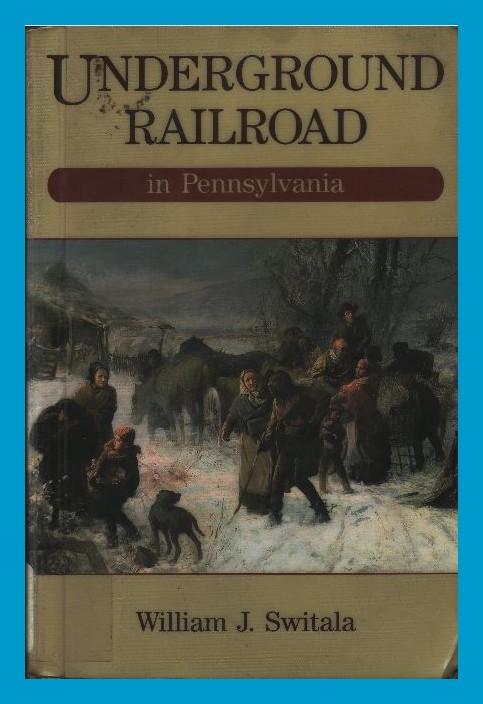
Switala’s book is an excellent resource for understanding the importance of Harrisburg in the history of the Underground Railroad, particularly in the routes through central Pennsylvania. The final post in this series will look at one of the northern routes which ran right through Dauphin and Northumberland Counties.
___________________________________
Previously posted on The Civil War Blog on April 11, 2011.
Corrections and additional information should be added as comments to this post.
[African American]
[Indians]