From about May of 1921 through July 1922, Fred P. Margerum of Elizabethville, Dauphin County, Pennsylvania, served in a humanitarian capacity as a field commander for Near East Relief, a privately funded group that worked to alleviate the horrid conditions in the Near East that were brought about after the Armenian Genocide and World War I. While in Armenia, Margerum frequently communicated with family and friends back home in Elizabethville. While not all of his letters have survived, some were reported in newspapers throughout the country and are repeated here in this blog post. The news articles were used to encourage donations of money and clothing.
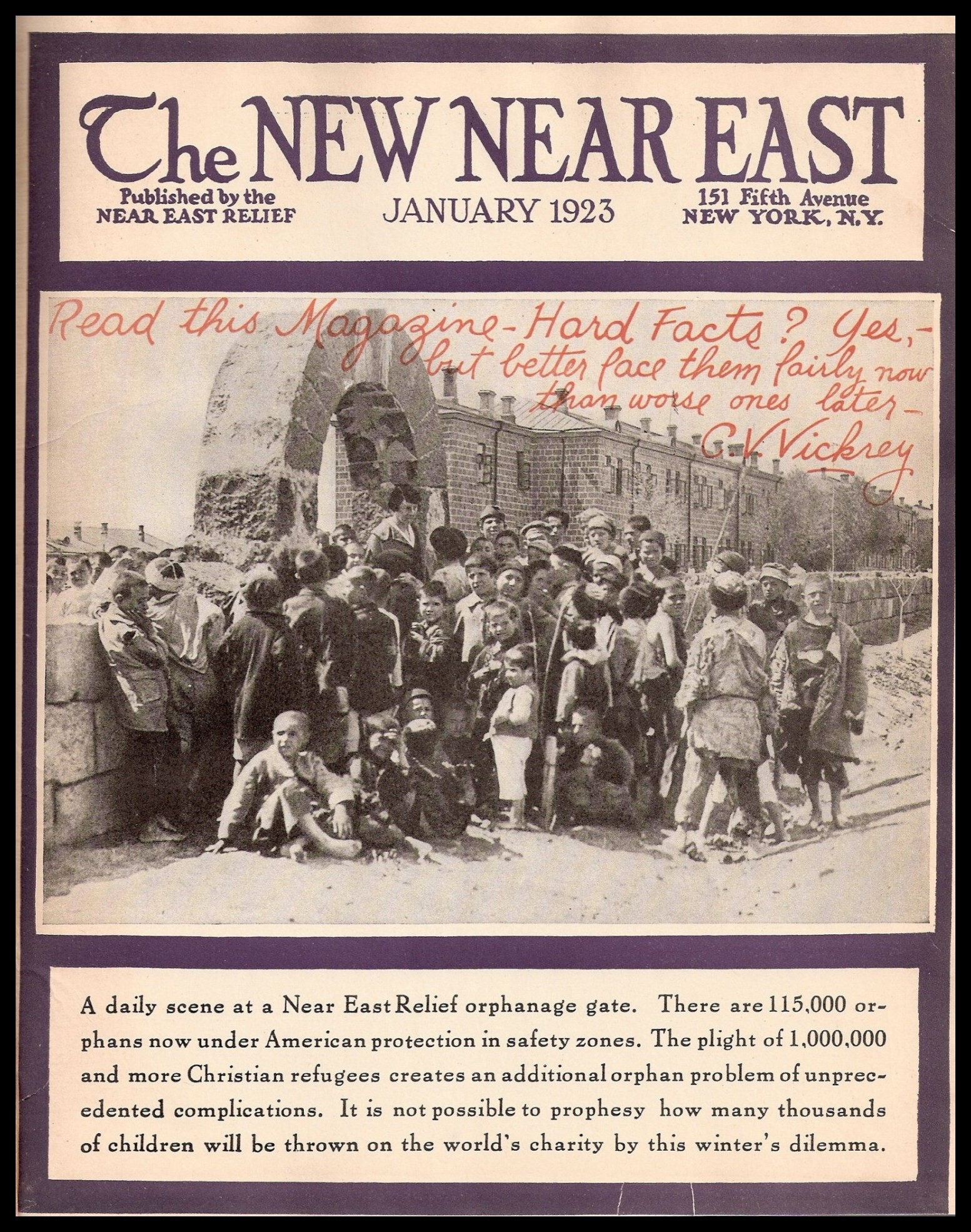
Above is the January 1923 cover of The New Near East, monthly magazine of Near East Relief, picturing:
A daily scene at a Near East Relief orphanage gate. There are 115,000 orphans now under American protection in safety zones. The plight of 1,000,000 and more Christian refugees creates an additional orphan problem of unprecedented complications. It is not possible to prophesy how many thousands of children will be thrown on the world’s charity by this winter’s dilemma.
Also on the cover (in red), is a note from C. V. Vickrey:
Read this magazine – hard facts? Yes, but better face them fairly now than worse ones later.
_________________________________________
From the Harrisburg Telegraph, August 2, 1921:
FRED P. MARGERUM OF ELIZABETHVILLE FINDS RESOLUTION IN TIFFLIN
New York, August 2 [1921] — Tiflin, capital of the little Transcaucasian Republic of Georgia, once known as the “Paris of the East,” is now a city of desolation and misery, with little happiness and comfort save that which American workers of the Near East relief are able to supply.
This is the summary of a report reaching headquarters of the relief organization here to-day from Fred P. Margerum, formerly a prominent manufacturer of Elizabethville, Pennsylvania, and now a member of the American relief personnel in Tiflin.
“There is widespread poverty,” he declares in his report.
________________________________________
From the Harrisburg Evening News, February 9, 1922:
Former Elizabethville Man Writes on Armenia
The deplorable conditions existing in Armenia, where the Winter found thousands without sufficient clothing and food, are described in a letter from Fred P. Margerum, district commander for the Near East Relief at Polygon, near Alexandropol, a former treasurer of the Swab Wagon Works in Elizabethtown [sic], to several of his friends here.
According to the letter, children wearing shoes are a rarity and in numerous cases amputations of the frozen feet has been necessary to save the lives of unfortunate children. There is not nearly an adequate supply of clothes and food for the children, while the adults are suffering in proportion, Margerum writes.
_________________________________
From the Bangor Daily News, Bangor, Maine, February 24, 1922:
Many Little Children with Frozen Feet
American Physicians Contending With Cold and Famine Horrors in Near East
Amputation of the feet of children, frozen repeatedly as the result of long wandering through the snows of the Caucasian mountains, is the latest horror that workers of the Near East Relief have to deal with in hunger-swept Transcaucasian Russia, according to Fred P. Margerum, the American director of one of the relief orphanages in Alexandropol, Armenia.
“This treatment is made necessary when gangrene sets in,” he says, “and gangrene frequently follows where undernourished, ill clad bodies are exposed to the rigors of a bitter region where the altitude is about 5000 feet.
“What makes it all the worse is that we could save these children if we only had the room in our orphanages and hospitals to put them in, and the food to give them when they had been admitted. But our buildings are all overcrowded. In some cases the children are sleeping four and five in a double-decked, home-made bed. Our food supplies are always on the point of giving out, and we cannot further reduce them. For we must always keep insured against the possibility of not being able to bring any more supplies in.”
Amputated feet are not the only peril facing the little tots of the Near East, where war has not ceased since 1914, according to Charles V. Vickrey, general secretary of that organization. “Dread trachoma, with its heritage of blindness in the children, is a scourge against which half a dozen American physicians in the service of the Near East Relief have pitted all their skill,” Mr. Vickery declares. “Only a short time ago, one of these heroic physicians, Dr. Blanche Norton, herself contracted trachoma while caring for the children in our trachoma hospital. Nine American relief workers have laid down their lives in this work of mercy since 1919 – dead in the field of honor.”
Albeit 110,000 children, mostly orphans of war and massacre, are today being cared for by American charity, relief officials declare that there are fully 200,000 others, rag clad, hungry and frequently wandering through the snow like animals, living on offal, who are clamoring for admission to the American orphanages established throughout the Near East. As the Near East Relief disposes of no government funds, it was found necessary to cut the usual appropriations for funds 25 per cent, at the last meeting of the executive committee of the organization.
Note: The Margerum quotes as well as the information about trachoma and the numbers of homeless orphans cared for by Near East Relief were later published in the Leader-Telegram, Eau Clair, Wisconsin, May 19, 1922.
_________________________________
From the Hartford Courant, Hartford, Connecticut, March 12 1922:
FUNDS FOR ORPHANS GIVEN BY HOMELESS
New London County Children Raise $36 For Near East Relief
Meigs H. Whaples, state treasurer of the Near East Relief, has received a check for $26 from Mrs. Martha H. C. Mitchell, a member of the state department of public welfare, representing a total of contributions to the starving children of the Near East raised by the children of the New London Country Temporary Home, many of them orphans, on their own initiative. The check was accompanied by the following letter:
“I am sending you a check for thirty-six dollars asking that you will pass on that amount for the assistance of “The Starving Children” of the Near East, who are in the minds of the children, inmates of the New London Country Temporary Home, who with their matrons, collected this sum in their sympathy for these other children. You may be interest to know that almost all of the children in the home desired to give all of the bright quarters given to them at Christmas for their own pleasure, to this fund.”
State Director, E. H. McDonough of the Near East Relief, has received word indirectly from Fred P. Margerum, formerly a prominent manufacturer of Elizabethville… now a district commander for the Near East Relief at Axexandropol that doctors of the organization have been compelled this winter to amputate the feet of several homeless children for whom room could not be found in the orphanages. The amputations were due, the information says, to repeatedly frozen feet leading to gangrene. The orphanages are said to be crowded to the danger point in the effort to safe as many of the children as possible.
__________________________________
From the Elizabethville Echo, April 27, 1922:
A LETTER FROM MR. MARGERUM
Box of Clothing Reaches Armenia
Mrs. Collier recently received a letter from Mr. Margerum who is in the Near East relief work in Armenia, in which he tells of his surprise when he opened a box and discovered that the clothing, etc., which it contained had come from some Elizabethville people. Following is the letter:
Karaklis, Armenia, March 19, 1922
My Dear Mr. Collier,
It has been more than a week since a box came to Karaklis addressed to me. All that I knew was that it was sent from America.
Many times I wished I could open it but no opportunity came until this afternoon. There was no mark on the box to indicate the original point of shipment. I was happy to find, however, that it contained shoes and clothing and of quality far above that of the average that we get.
I hurried to find some mark that would tell me where the goods had come from. I first came upon a coat that had been sold by Dives Pomeroy and Stewart of Harrisburg.
My interest was increased. The next thing, which settled the question, was a coat that I recognized as once having been my own. I began going through pockets, not to find money, but something to tell me from whom the various garments had come. In a pocket of one jacket I found a piece of paper, pinned fast, and on it was written, Mrs. Carrie Collier, Elizabethville, Pennsylvania. The men who were with me knew nothing of what thoughts came to me just then because I said nothing and they could not see my eyes fill up because I turned my back to them. To come upon that little paper made me feel that you had waved your hand to me. It seems that no one else in Elizabethville thought of doing what you did. In the pocket of a man’s coat I found a letter written to Professor App a year ago. By that letter I know that Professor App sent that coat over. There is one package of underwear in the lot to which is sewed the back of an envelope and on it is written “Here are two shirts alike, give them to someone they will fit.” No name is signed and try as hard as I could I was not able to identify the hand writing. I handled all of the pieces of outer clothing several times, trying to determine the names of the senders, but I cannot remember having seen certain people at Elizabethville wearing these clothes, except those worn and sent by the members of my own family. It would have been extremely interesting had each one who donated clothing pinned identification paper thereto.
In the name of these people, I want to thank you for your gift. Many hearts will be made happy when I distribute this fine lot of equipment. It is the finest lot of clothes I have handled. Since I have been here in Armenia, I have personally supervised the sorting and distributing of more than a thousand bales. Many have contained little better than rags. In this box are many garments which seem almost too good to give out and there is not a single piece that cannot be immediately used. To me this is mot remarkable. The shoes too were all in pairs and none worthless. This is extremely unusual. I want to thank all who contributed and I reckon the best way will be to do so through the local paper, but I want to thank you in particular.
Mr. Collier, if I would undertake to tell you what the conditions are in this part of God’s world you could hardly believe what I would write. I will sum it up by saying that I cannot conceive how they could be worse. To go into details would be too gruesome. There can be no lower level than that reached by these Armenians. I write at length to Mrs. Margerum, altho there is much that I would not tell her. If you have not already gotten detailed information about conditions here, from Mrs. Margerum, I know she will be glad to tell you anything you may wish to know.
Very sincerely yours,
FRED P. MARGERUM
Give my regards to Ray and Reed.
_______________________________
From the Pratt Union, Pratt, Kansas, May 3, 1922:
FROZEN FEET AND HUNGRY
Amputation of the feet of children as a last resort after repeated freezings is the new aftermath of war in the Near East, according to Fred P. Margerum, former prominent manufacturer of Elizabethville.
It is a result of no shoes and prolonged wandering without care in a very high altitude, says Mr. Margerum, writing from the Caucasus.
“I dread to think of those frozen feet,” continues the letter, “for to some of those children it means gangrene and amputations.”
“Today, a hundred hungry, shivering and almost naked youngsters were at the door. They were a sorry looking lot. Most of them, after a bath, warm clothes and supper, landed in our hospital.
“I contrast this with the surprise which was given us on Thanksgiving day. As we were at breakfast, our attention was attracted by the noise outside of many voices. Prolonged cheers, straight from the hearts of a thousand or more children from our orphanage school, greeted us when we appeared. Then in a moment a great chorus of those young voices broke forth in the singing of the first verse of our beloved “America.” Some English-speaking school teacher had taught them the tune and the words and had succeeded in keeping it secret.
“How much would that have meant to the thinking people of the United States could the Armenian environment have theirs for a day?”
Mr. Margerum is district commander for the Near East Relief at Alexandropol.
Note: Portions of the above article, including the Margerum quotes, were also published in the Meade Globe, Meade, Kansas, May 11, 1922, under the title, “Amputation Last Resort.” Also, under the title, “Children Have Feet Amputated,” portions of the above article appeared in the Manchester Motor, Manchester, Kansas, May 4, 1922.
_________________________________________
From the Stockton Review and Rooks County Record, Kansas, May 11, 1922:
HEARTS TOUCHED BY CHILDREN’S SUFFERINGS
Practically every convict in the Virginia State Penitentiary contributed a fund of $91.46, recently raised at the institution for the assistance of the Near East children. The fund represents 914 days of hard labor at a rating of 10 cents a day. No man gave less than a day’s pay, and a few donated a month’s wages. Touched by the pitiful conditions of these unfortunate little ones, every one of the inmates in the institution gave freely from their little hoards of money to the cause.
Amputation of the feet of children as a last resort after repeated freezing is the new aftermath of war in the Near East, according to Fred P. Margerum, formerly a prominent manufacturer of Elizabethville, and now the district commander for the Near East Relief of Alexandropol.
It is a result of no shoes and prolonged wandering without care in a very high altitude.
Scores of homeless children are brought into the Near East relief orphanages with feet unprotected from cold, he writes from the Caucasus.
________________________________________
From the Ithaca Journal, Ithaca, New York, May 12, 1922:
Near East Drive Starts Saturday; Trucks to Call For Used Clothing
The collection of used clothing to be sent to the suffering people of the Near East will begin in Ithaca [New York] Saturday morning at 9 o’clock and continue until 5 o’clock and continue until 5 o’clock in the afternoon, during which time it is hoped to cover all the streets of the city. A number of trucks and automobiles will be used to cover the territory and the Boy Scouts have volunteered to help with the collection.
All persons having clothing to contribute are requested to place the bundles, ready tied up, outside their doors, so that no time may be wasted in collecting them.
Women in Armenia will walk miles for a few cast-off garments in which to clothe themselves and their children, says Fred P. Margerum, a Near East Relief worker at Alexandropol.
“They gather at the door of the warehouses in hordes,” reports Mr. Margerum in a letter to friends in America. “I was there a few days ago. When I saw the condition of those women I went into the old clothes room and got sacks of rags thinking I would scatter them among the crowd and perhaps provide them with bits of cloth they could sew together into some sort of coverings for their bony bodies. Many carried little babies. i tossed one armful of rags into the mass. The became frantic and fought for the bits of goods. I did not dare continue, or there would have been a riot. They wept, they knelt before me and embraced by legs. Mothers held out their babies that I might see how they suffered. Only a man with a stone heart could look upon what I must and not pray for wisdom to enable him to do more, help more, give more.”
Note: Portions of the above article, including the Margerum quotes, also appeared in the Yonkers Statesman, Yonkers, New York, May 9, 1922, in an article titled, “Remember Bundle Day on May 15th: Old Clothes Sorely needed in Near East.”
_____________________________________
From the Daily Southerner, Tarboro, North Carolina, May 23, 1922:
LITTLE TO YOU, MUCH TO THEM
Last year America sent 1,000 tons of clothes to the Bible Lands. The supply is now exhausted. Numberless men, women and children are destitute of clothing and thousands have no covering whatever, save the thinnest rags.
“Common labor is required of all refugees physically able to work,” reports R. M. Davidson, from the Caucasus. “Many of them, alas, underfed and undernourished, have not enough clothes to keep them warm when working out-of-doors in freezing weather of this altitude.”
“In spite of a recent gift of 224 pairs of new stockings, and 376 pair of shoes, not new, but reconstructed, many feet are still bare, or little better, in stockings only in mud and snow,” writes Miss Mabelle Phillips, orphanage superintendent in Djalal-Oghli district.
“Frozen feet, which often lead to gangrene and amputations, are described by Fred P. Margerum, a worker in the field.
The clothing cast aside as worthless by our people here in America would provide comfortable covering for every unclad person in the Near East, and would be an untold blessing to thousands who have been stripped of all their possessions. This clothing can be transferred to them through the agency of the Near East Relief, incorporated by Act of Congress to relieve the suffering in that country.
In a previous clothing campaign, Philadelphia adopted the slogan, “the Plea that Touched the Heart of Philadelphia.” Fourteen carloads of old clothing was the answer. Such a plea should touch the heart of every city and country, and bring its answer clear and strong.
It is such a little thing for an American to dig those cast-off garments out of the clothes box and send them down to the Bundle Station, but to at least one, and perhaps several hundred human beings in that far-off land, it may mean the difference between life, hope, strength — and almost certain death….
Note: The above article was also published in The Item, Sumter, South Carolina, March 31, 1923, under the title, “Near East Bundle Days: An Appeal for Old Clothing For Near East War Sufferers.”
____________________________________
From the Elizabethville Echo, July 13, 1922:
Mr. Fred P. Margerum has returned to the United States after more than a year’s service in Armenia. A radio message on Tuesday by way of Norfolk, Virginia, informed his son, Jonas that he would arrive home, Saturday the 15th.
________________________________________
News articles from Newspapers.com.
Corrections and additional information should be added as comments to this post.